
Rocky
An iPhone app that watches you boulder and tells you how to climb better. It finds the holds on a wall, groups them by route, and tracks your body through a recorded climb.
In the app
What it is
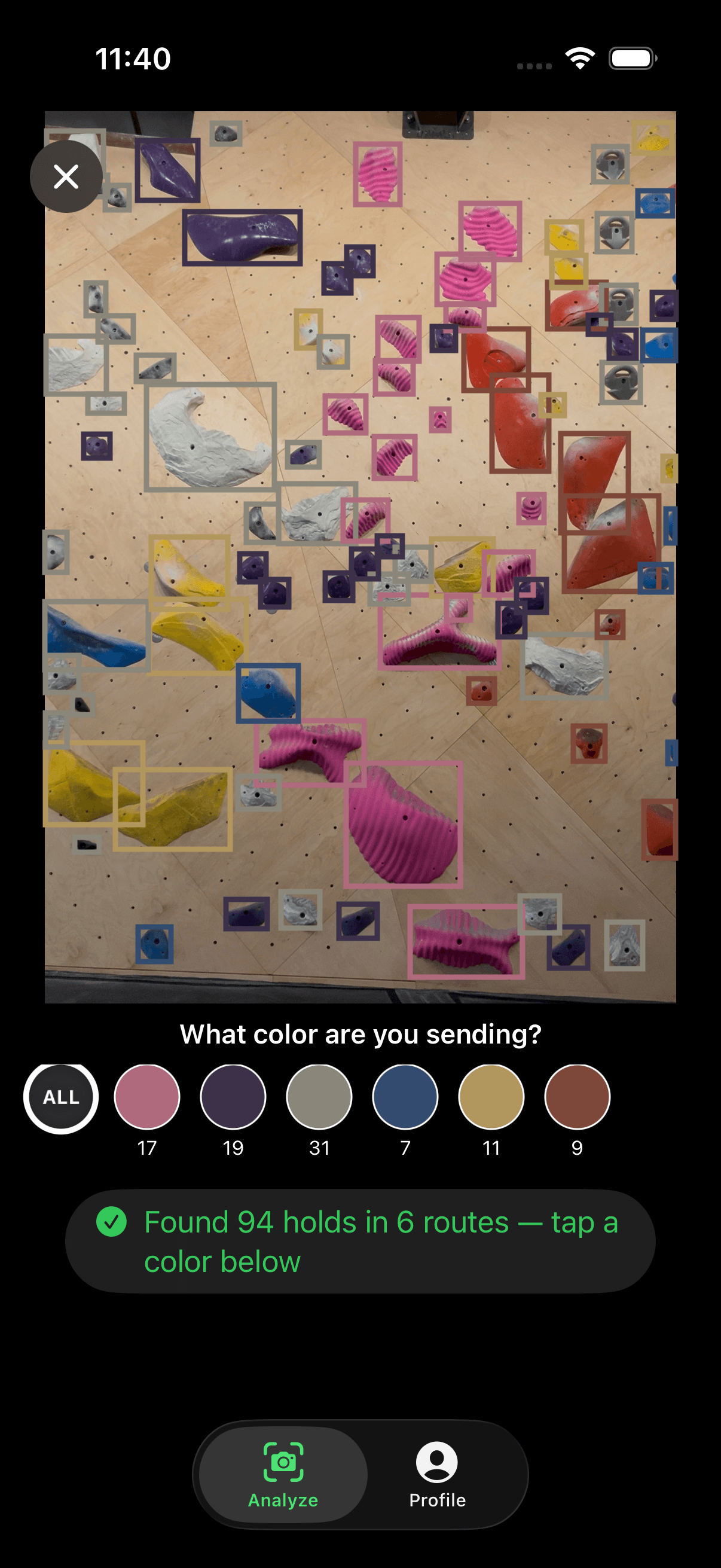
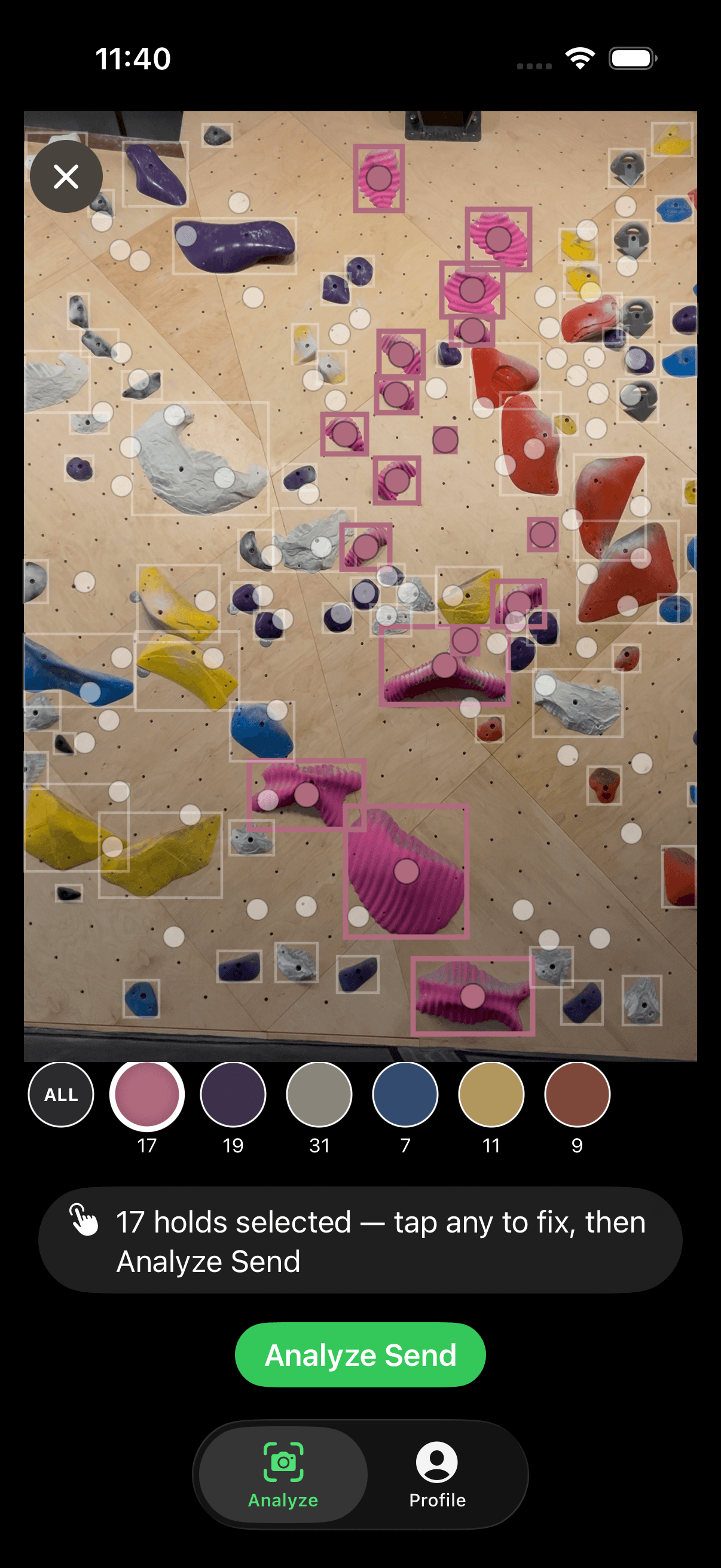
Rocky is a climbing coach I'm building for my own sessions, and a way to learn computer vision, backend design, and iOS on one real problem. Today it does two things. Photograph a wall and it boxes every hold and groups them by route colour, with a tap to fix anything it gets wrong. Record a climb and it returns the clip with a skeleton tracked over your body. The part I'm working on now joins the two: working out which hold each hand and foot is on, so a clip becomes a sequence of moves that technique feedback can be built from.
How a climb moves through it
- iPhone appTakes the wall photo and records the climb.
- FastAPICreates the climb and hands back a short-lived upload URL.
- Cloudflare R2The phone uploads the video directly, so the API never touches the bytes.
- Redis queueThe API enqueues the analysis and answers right away.
- WorkerRuns hold detection and pose tracking on the clip.
- Back on the phoneThe app polls for the result and draws holds and skeleton over the footage.
Build log
- 0Done
Plumbing
Record on the phone, upload to storage, get a response from a deployed server.
- 1Done
Hold detection
Photograph a wall and see every hold boxed and grouped by route colour.
- 2Done
Pose tracking
Upload a clip and play it back with a skeleton over the climber.
- 3In progress
Move segmentation
Line up holds with joint positions to turn a clip into a list of moves.
- 4Planned
Technique feedback
Hip distance from the wall, hesitation before a move, foot precision, as notes timed to the clip.
- 5Planned
Accounts and history
Sign in, keep every climb, and see how technique changes over time.
- 6Planned
Grading
Relative difficulty first: harder or easier than your last few climbs.
What I learned building it
Colour is not RGB
The first version grouped holds by raw RGB and produced muddy browns and greys, because gym lighting changes how bright each hold looks far more than it changes its hue. Dropping brightness and clustering on hue and saturation alone fixed it: on my test wall it picked six groups, matching the six routes actually set.
A detector on a free tier
The server has roughly 512 MB of memory and PyTorch alone uses more than that. I exported the trained model to ONNX and wrote letterboxing, box decoding, and non-max suppression by hand, so the deployed API runs on ONNX Runtime and NumPy with no PyTorch installed.